Q1) What is your coaching philosophy?
I can teach you and I can guide you but you have to do your part. Don’t expect miracles.
Q2) How do you structure your lessons i.e. what can a student expect during a typical coaching session with you?
I’d like my students to do their proper stretches before our session so we can go into relevant stuff quickly. I would usually recap what the student had done in the previous session with me before I plan out the next skill progression.
Take a beginner. In the first session, we’d keep it simple and focus on how to grip the paddle and making contact with the ball with some basic movements. In subsequent sessions, we’d progress to transition, drop shots, resets, volleys and retrieving shots etc. I’d typically suggest 4 sessions for a beginner.
Show More ↓Q1) What is your coaching philosophy?
I can teach you and I can guide you but you have to do your part. Don’t expect miracles.
Q2) How do you structure your lessons i.e. what can a student expect during a typical coaching session with you?
I’d like my students to do their proper stretches before our session so we can go into relevant stuff quickly. I would usually recap what the student had done in the previous session with me before I plan out the next skill progression.
Take a beginner. In the first session, we’d keep it simple and focus on how to grip the paddle and making contact with the ball with some basic movements. In subsequent sessions, we’d progress to transition, drop shots, resets, volleys and retrieving shots etc. I’d typically suggest 4 sessions for a beginner.
I can do one-to-two sessions but I prefer one-on-one as two people could come from different backgrounds e.g. one with racquet sport experience and one without. So one-on-one is easier. The student gets more out of it and you’re in it 100%.
Tess herself does not come from a racquet-sport background; she was a volleyball player in school so she feels she’d ‘get’ people who are totally new to Pickleball without any racquet-sport experience.
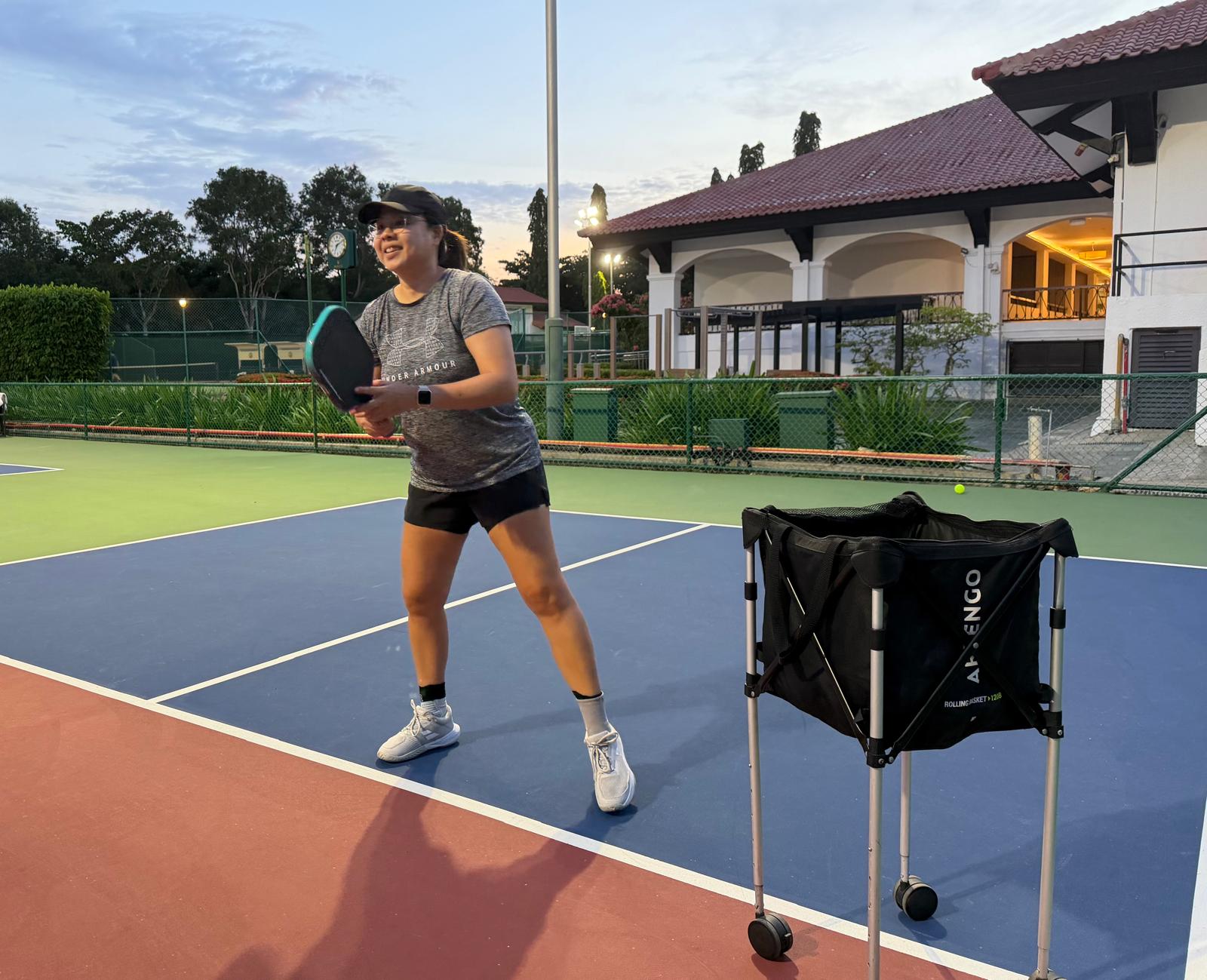
Q3) What is a non-negotiable Pickleball stroke/skill that you believe every student must/should learn and master?
The basic thing that every Pickleball player must know is where you should take the ball at i.e. where your paddle should contact the ball for your forehand and backhand.
You have to really break it down. Do the first part (paddle face down), then the second part (keep low, stay low), then the third part (using clock hands to indicate where to contact the ball), then add them all together.
[Image 1]
Your student must know what you are referring to so they can execute on cue. It's not easy especially when you have to react in split seconds during game play but with repetition, the student will realise, learn and be aware and ready.
Q4) How do you maintain patience with students who may take longer to grasp concepts? Would you tell a student that Pickleball may not be for him/her?
Coaching is like therapy. What works for one student may not necessarily work for another. So as a coach, you need to be adaptable in terms of your communication.
If the students themselves think that they are prepared to learn and feel they are improving, you should encourage them. As a coach, you may know how a technique should be executed but if the student cannot execute it in the way that you want, does that mean it's not right? As long as the student can return the ball, placement becomes more important than execution.
Of course, for beginners you can tell them this is not the right way. And you may want them to do the same thing over one or two weeks to inculcate the habit — but the student may think they are wasting time with a coach who is always making them do the same thing. It's subjective and always a dilemma.
I also think the money part comes in because if you want the students to keep coming back there is the 'please the customer' thing, right? That's why I don't coach for a living. I commit one hour a day, max two — that's enough for me. Unlike those who earn their keep coaching; they do 6 to 7 hours a day, every day.
Q5) Tell us about a rewarding/memorable moment where a student of yours made you proud?
I’m still very young in my Coaching career so I would say unfortunately I haven’t had that memorable moment yet. I do remember this one student who came to me with zero expectations, like she didn’t even expect to hit the ball but by the end of our first session,she realised she had good ball sense and was hitting the ball quite well. She was quite pleased with herself and said, "Oh, I didn’t expect I can do this."
She liked my structured plan and gave me positive feedback. It made me happy that I was doing this and didn’t fail her expectations. That’s why most of my students are referrals or through word-of-mouth. Plus I don’t do any advertising, social media promotion etc.
Q6) What advice would you give Pickleball enthusiasts who may be considering Coaching as a side-hustle or a full-time gig?
Yeah, go for it. But know that it’ll come down to how you distinguish yourself. You have to stand out, right? Especially when you want to make a living out of it. What makes you different from the other coaches? You have to market yourself. Are you prepared for setbacks like not getting students?
My advice would be to work out how much you need to get by financially. You need to give yourself at least 3 months to build a base. So don't do anything stupid like quit your job before that. I see many people getting their coaching badges. It is important that they get them from recognised places, like RPO.
I didn't do RPO or IPA or BPR because I wanted to do one that is recognized in SG so I did IPA and PPR but…do you really need a coaching badge to coach? If someone sees that you can play and have good strokes plus can communicate well, what’s stopping him/her from asking you to be their coach?
In many cases, you can get away with teaching beginners but it’d be tough with intermediate and above. It’s also important that you are competitive yourself. We have a large pool of coaches coaching Pickleball these days but they themselves don't play.
🎓 Coaching Qualifications & Certifications:
SG Coach Excellence Programme
— Pickleball Level One (Technical), 2025, CoachSG
The Science of Video-based Analysis in Sports
— Notational Analysis, 2024, Republic PolytechnicStandard First Aid with CPR (HO) + AED, 2025, St John Singapore
Years of playing Pickleball: 7 years
Years of coaching: 2 years
🏆 Accolades / Medals / Awards Won:
Singapore Open 2026
Bronze — Masters Mixed Doubles (Open)
Taiwan Open 2025
Silver — 35+ Mixed Doubles (5.0)
Pesta Sukan 2025
Gold — Masters Women's Doubles
Gold — U14 Split Age Mixed Doubles
Bronze — U18 Split Age Mixed Doubles
PickleSlam 2025
Gold — 35+ Women's Doubles (Open)
Silver — 35+ Mixed Doubles (Open)
Singapore Open 2025
Gold — Masters Mixed Doubles (Open)
Silver — Masters Women's Doubles (Open)
The Flying Pickle Tournament 2025
Silver — Open Women's Doubles
Skechers Siam Pickleball Tournament 2024
Bronze — 35+ Women's Doubles (Open)
Bronze — 35+ Mixed Doubles (Advanced Plus)
CelcomDigi Open 2024
Gold — 19+ Women's Doubles (Open)
Bronze — 35+ Mixed Doubles (Open)
Pesta Sukan 2024
Bronze — Masters Women's Doubles
Singapore Open 2024
Bronze — 35+ Mixed Doubles (Open)
Asia Pickleball Open 2024
Silver — 35+ Mixed Doubles (Advanced Plus)
4th — 35+ Women's Doubles (Open)
Skechers Siam Pickleball Tournament 2023
Gold — 35+ Mixed Doubles (Open)
Silver — 35+ Mixed Doubles (Advanced Plus)
Asia Pickleball Games 2023
Bronze — 35+ Team Event (Open)
World Pickleball Championship 2023
Gold — 35+ Mixed Doubles (Advanced Plus)
4th — 19+ Women's Doubles (Open)
Pesta Sukan 2023
Silver — 19+ Women's Doubles (Open)
Singapore Open 2023
Gold — 19+ Mixed Doubles (Open)
Asia Pickleball Open 2023
Silver — 35+ Mixed Doubles (Advanced Plus)
Bronze — 35+ Women's Doubles (Advanced Plus)